
02.Dec.2025
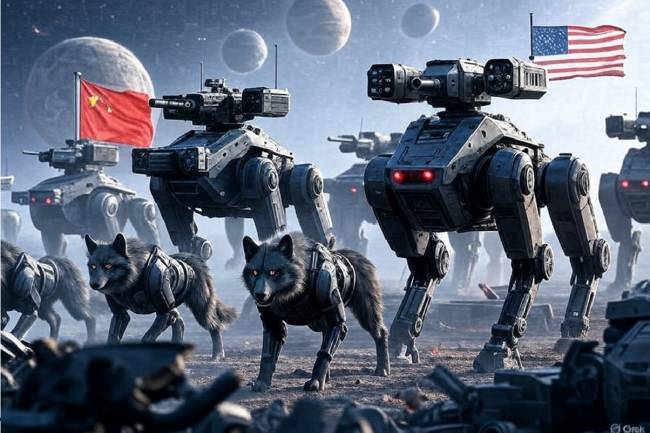
The People’s Liberation Army (PLA) made a massive leap in military robotics in 2025. Four-legged “robot wolves” and humanoid combat robots were openly tested during amphibious assault exercises in the Taiwan Strait. These developments are not only transforming only China’s defense strategy; they are shaking the global balance of power. While competing head-to-head with U.S. giants like Boston Dynamics, Chinese companies such as Unitree Robotics and Deep Robotics are dominating with high-performance, ultra-low-cost platforms. In this article, we examine China’s newest combat robots, their technical specifications, and how they stack up against rivals from other countries.
Why Now? China’s Robotic Breakthrough in 2025
2025 has officially become China’s “Year of Humanoid Robotics.” The Ministry of Industry and Information Technology published the “Guiding Opinions on the Innovative Development of Humanoid Robots,” providing a strategic roadmap for the entire sector.
The PLA aims to minimize human casualties through “human-machine integration,” using robots as the spearhead in future urban combat, especially in a Taiwan scenario.
At the Victory Day parade in September 2025, unmanned ground combat vehicles were showcased for the first time. In October, state broadcaster CCTV-7 aired footage of the PLA’s 72nd Group Army deploying “robot wolves” in live amphibious assault drills – clear proof that the technology has moved from experimental to operational status.
According to Chinese military expert Wang Yunfei, these machines mark the end of “human-wave tactics” and the beginning of “intelligent maritime tactics.”China’s Top Combat Robots Deployed in 2025
China’s military 5G network can simultaneously control over 10,000 robots within a 3 km radius, enabling true swarm warfare.Head-to-Head Comparison with Global Rivals (2025 data)
Model / Company | Country | Weight / Speed | Payload | Est. Cost | Key Strengths | Advantage / Weakness |
|---|---|---|---|---|---|---|
Robot Wolf (Unitree GO2 Pro) | China | 70 kg / 5 km/h | 25 kg (moving) | $3,500–10,000 | 360° vision, weapon mount, 5G swarm | Extremely cheap, swarm-ready; lighter armor |
Spot (Boston Dynamics) | USA | 25 kg / 5.7 km/h | 14 kg | ~$75,000 | Superior autonomy, rugged build | Expensive, limited military adoption |
Digit (Agility Robotics) | USA | 35 kg / 2.5 m/s walk | 18 kg | $100,000+ | Logistics-focused AI navigation | Slow, 10× more expensive than Chinese |
M-81 | Russia | 50 kg / 4 km/h | 20 kg | Unknown | Rocket launcher integration | Experimental, reliability concerns |
Vision 60 (Ghost Robotics) | USA | 22 kg / 7 km/h | 15 kg | ~$150,000 | Modular weapons, military-grade | High cost, slower mass production |
Bottom line:A Chinese Unitree robot wolf is roughly 20 times cheaper than a Boston Dynamics Spot while carrying almost twice the payload. The U.S. still leads in software autonomy, but China dominates in production speed and swarm integration (10,000+ units simultaneously).
Ethical Concerns and the Road AheadThe PLA itself acknowledges the risk of “indiscriminate killing” by humanoid robots and has called for new ethical guidelines. Experts warn that 2025 marks the beginning of a new “killer robot” arms race. While the U.S. plans to deploy thousands of autonomous drones by year-end, China is developing a robotics equivalent of “ChatGPT” using its DeepSeek AI model.
China’s move is fundamentally changing the nature of war: fewer human lives lost, many more machines on the battlefield. Yet ethical, legal, and strategic risks are rising fast. More live tests are expected in the pipeline for 2026 – the world is watching.
Sources: Defense One, Reuters, CCTV, Global Times, ThinkChina, Interesting Engineering and industry reports. Opinions are those of the author.

Millivolt Net Youtube Channel
Electronic training videos
10.03.2023

Cloud Computing and IoT Applications
Overview of cloud computing and IoT concepts
13.04.2023
Top 10 IoT Cloud Platforms for ESP32, nRF, and STM32 Projects in 2025
Top 10 IoT cloud platforms tested in 2025 with real ESP32, nRF, and STM32 devices: free tiers, setup times, and performance comparison.
02.12.2025

What is IoT?
IoT, IoT concept, overview
07.12.2022

Where is the limit of wearable technology?
The future of wearable technology
16.12.2022

Why should we teach electronics to children?
Necessity of electronics and software training
25.12.2022

The impact of iOT in the agricultural industry
Use of new technologies in agriculture, IoT, Artificial Intelligence
17.01.2023